Born in the USSR in 1970, Russian by both nationality and ethnicity, and as such, have my own opinion on everything.
People, just try to think different. Maybe it won't make you happier, but the world will be a much better place to live in, if populated by thinking people.
You might not speak Russian, however, it won't prevent your enjoying the wonderful 360-degrees video.
Because war speaks one language.
As the country which suffered the true total war unleashed by Hitler, we have sincere and deep respect to all those who fought Nazis, whatever language they spoke and uniform they wore.
Hopefully, the lessons of early 1940s and 1975 will sometimes be learned. We could be allies against evil and for the progress of mankind; that means, so we can in the future, sooner or later.
It was a nice and quiet Sunday morning of June 22, 1941, when Hitler started the most terrible and devastating war our great country ever experienced.
In just days "The Sacred War" became kind of an unofficial anthem of the fighting Soviet people.
Multilingual titles included.
The meaning of the War for us Russians (including Ukrainians and Belorussians, for the matter) is often underestimated by the Westerners.
According to the state statistics (the accounting lasted for decades, and seems unfinished till now), the Hitlerites, their satellites and collaborators intentionally killed 7,420,379 civilians on the occupied territory uf the USSR. More than 1.7 million of Soviet Ostarbeiters died in the 3rd Reich, and 450+ thousands of those who survived, did not return back; the country lost them all. Approximately 4.1 million of civilians died on the occupied territory due to unbearable conditions of the regime installed (hunger, diseases, lack of medical assistance, etc.). Thus, for the USSR the "New Order" cost was at least 13.7 millions of civilians alone.
The war led to a considerable increase of child mortality; extra 1.3 million children born during the War, did not survive it (calculated on the base of death mortality in 1939-1940).
To save the Motherland, 8,668,400 soldiers gave their lives.
Taking into account demographic losses, we come to the unthinkable figure of 26.6 million people — and it's the lowest possible strictly scientific calculation.
This was in fact a genocidal war. Quite possibly, the very collapse of the USSR in 1991 became a postponed consequence of it.
Even now I tend to stand up when hearing the song above — just like the people do in the video, my fingers make fists, and tears come to eyes. And I am a grandson of those who fought and survived the War.
The war we understandanly call the Great Patriotic. And my feeling is that we will never forget it — as long as Russia exists, as long as there are Russians (of all 190+ ethnicities) in Russia.
Well, I am not going to discuss the evident fact of Russia being resurgent; I'm rather into another evident fact: this is an insufferable event for some of the big guys around there, and Philip Breedlove is not an exception.
The very idea of bringing back U-2 for surveillance over Russia sounds as kind of a mental diagnosis to a formerly brave US fighter pilot and presently NATO supreme allied commander, who is to step down this spring.
56 year ago, on May 1, 1960 a U-2 did a great service in breaking US-USSR relations; Gary Powers did not commit suicide... Surely, for the US military those were good old times and bright hopes; a great war seemed to be round the corner. Luckily, then, in the sixties, big guys succeeded to overcome all crises and kept the strategic peace till now (I am not talking about local wars; those bloodsheds did not threaten the very existence of life on Earth).
Now, in 2016, the Breedlove's idea is not only desperately outdated; it puts under question the very ability of the high-ranked military to perceive reality adequately.
The current year started with a prominent interview of Vladimir Putin to the German Bild. He spoke to German journalists on January 5.
Here goes the "original" German version. Why did I put the word 'original' in the quotation marks? The answer is pretty simple: it is a German text; that means, a translation of the words our president said to the interviewing staff in Russian.
For those of you, who do not speak or even understand German, the title goes: "Why Did Putin Frighten Merkel With His Dog". And the subtitle below: "Vladimir Putin explains his world: the NATO is agressive, Merkel is earnest, and the Russian Crimea is a God's justice".
You like it or not, that's what the Bild wrote in German.
Being a major German paper, they published the English translation of the interview as well. Here it is.
That's the title of a movie that is rapidly approaching theaters; its premiere is expected early next year. Here goes its official trailer.
Titles are provided in Chinese, Czech, English, French, German, Italian, Polish, Portuguese, Serbian (Latin), Spanish, and Turkish languages.
The movie is devoted to one of the toughest episodes of the WW2 (and, for the matter, the Great Patriotic War, as it was for the USSR, and remains for us its ex-people): defence of Moscow from advancing Hitler troops in October-November, 1941 by men of the 316th Infantry Division under command of Major General Ivan Panfilov.
For the mass bravery and heroism of its men the Division was awarded and became the 8th Guards Infantry Division on November 18, 1941; on that very day its commander was killed by an enemy shelling, and the Division was allowed to bear its legendary commander's name (there were only two Divisions in the Red Army that used names of their former commanders; the other one was named after Vasily Chapaev, a legendary hero of the Civil War).
The legend of the 28 Panfilov's men who stood to death on November 16, 1941 during the small Battle of Dubosekovo, skilfully used (and, for this particular case, evidently exagerrated) by propaganda system, effectively inspired Soviet people to fight and work harder. Anyhow, the Moscow was defended by many true self-sacrificing heroes; the Panfilov's Division alone lost more than 3600 men KIA and 6300 WIA. And the words of political officer Klochkov "Russia is a vast land, yet there is nowhere to retreat — Moscow is behind us!" were not an invention of journalists; it was the call — and the truth — of time. The movie is expected to resemble many thousands of individual and mass heroic acts that allowed our country to survive and win.
What is the most special thing about the movie, was the crowdfunding campaign its team used for financing the project at its initial stage. More than 34.4 millions Rubles were collected; it's not that much money for a movie production (slightly more than 0.5 mil. USD), however it is an unprecedented result for Russia, clearly demonstrating what we Russians would like to see in the theaters.
And the movie promises to become a real boom, as this perfectly made trailer clearly shows.
Today most Russians celebrate the 98th anniversary of the Great October Socialist Revolution — a brave attempt of some to make the life of all better. In many aspects, it was a great success, and even though the USSR failed early in 1990-s, its collapse had nothing to do with original ideas of common wealth. Old Russian calender was a bit behind of the world; the Bolsheviks adopted the common one in 1918, but the Revolution in Russia was in October, though for the rest of the world it was November 7.
As for today, I would express my sincere gratitude to General Major William Sidney Graves (1865—1940), who was in command of the American troops in Siberia in 1918—1920. His book "America's Siberian Adventure (1918—1920)" is a great evidence of what happened then in the Eastern part of our huge country. And of those 'Whites" who had nothing to do but lose the Russian Civil War, even agerssively supported and backed by foreign powers.
Admiral Kolchak surrounded himself with former Czarist officials and because these peasants would not take up arms and offer their lives to put these people back in power, they were kicked, beaten with knouts and murdered in cold blood by the thousands, and then the world called them "Bolsheviks." In Siberia, the word Bolshevik meant a human being who did not, by act and word, give encouragement to the restoration to power of representatives of Autocracy in Russia.
* * *
Semeonoff and Kalmikoff soldiers, under the protection of Japanese troops, were roaming the country like wild animals, killing and robbing the people, and these murders could have been stopped any day Japan wished. If questions were asked about these brutal murders, the reply was that the people murdered were Bolsheviks and this explanation, apparently, satisfied the world. Conditions were represented as being horrible in Eastern Siberia, and that life was the cheapest thing there.
There were horrible murders committed, but they were not committed by the Bolsheviks as the world believes. I am well on the side of safety when I say thatthe anti-Bolsheviks killed one hundred people in East-ern Siberia, to every one killed by the Bolsheviks.
A good propaganda does not necessarily mean to say something; sometimes it is absolutely effective to keep silence of this or that.
The Russian Service of BBC has recently announced a new OECD publication, "Health at a Glance 2015". Speaking about the life expectancy in different countries, an anonimous writer states:
Russia has one of the most unsignificant growth figure. As the organization says, in the 1970-s the average life expectancy of a Russian person was 68 years, and it increased to 71 years in 2013. Lithuania and Latvia showed comparable growth, though their figures were approximately one or two years more than that of Russia (73.9 and 73.5 years, correspondingly)...
What would an average British, or German, or, say, American citizen understand out of such a piece of data? While all the civilized world was steadily growing the life expectancy of its population, those evil Russians under their evil tyranny of Vladimir Putin almost stagnated, falling far behind the advanced nations. Putin must leave the Kremlin and let Russians live long and healthy lives!
And it would be a total and complete moronic bullshit, carefully created by pretty skilled in Russophobic matters BBC's staff.
'Cuz there were some events in between the 1970s and 2013 in Russia, you know.
When "the best German" Gorbi destroyed our country, and then betrayer and drunkard Yeltsin destroyed its economy, we had some troubles, you know. Statistics says, about 13 millions of Russian people prematurely died — losing the cold war turned out to be a quite bit hot for us Russians. My beloved father died at 63, and his early death belongs to this count as well.
So, when you come across some piece of news about Russia, it can in fact be a piece of shit prepared by skilled hands of propaganda cooks; and it's your choice whether to eat it or not.
With all my due thanks and best regards to blogger Fritzmorgen for the idea and picture.
And don't miss this once-in-a-life chance if you're lucky enough to be in London till March 13, 2016.
Story of space exploration is the story of great achievements of the USSR. The Sputnik opened the sapace age on October 4, First ever human in space, Yuri Gagarin, started his exciting travel as a 1st Lieutenant, and landed as a Major of the Soviet Airforce.
Being born in 1970, for the first 21 years of my life I was a Soviet citizen, that is, a citizen of the USSR. As such, I went through all the stages form an infant to schoolchildren to a conscripted soldier to a University student — the Soviet way. Surely and undoubtedly, this background has much to do with who I am now. And many of my compatriots who have gone through more or less the same way.
My friend Phil Butler insisted I had to share the experiences of my life. I did.
My sincere hope is that it helps our so sadly imperfect world to be a friendlier place.
Because mutual understanding is the first and maybe the most important key to peaceful coexistence. We are all different — but that's normal, just natural. And the world evidently needs more tolerance. Not just that to sexual choices, but a wider one — to ideas, ways of life, traditions and beliefs, so far these do not threaten other people and nations.
I did not include all the details in my text: it is an online article, not a kind of "War And Peace". But in case you have any questions, or you'd like me to throw more light on this or that part of our former life, feel free to ask. You can also get some more information about me in some of my posts here, tagged "me & my background".
I am here (and there, in the "Our Russia") to answer. To build up understanding.
As you may know, on June 22, 2015 the Council of the European Union took the decision (CFSP) 2015/971, correspondingly, of 22 June 2015, amending Decision 2014/512/CFSP concerning restrictive measures in view of Russia's actions destabilising the situation in Ukraine.
That is, the EU adopted some new sanctions against Russia and/or extended older ones.
Whether you like and agree with reincorporation of Crimea into Russia (what you call annexation, and we do not in no case); whether you like the new Nazi government of Kiev, Ukraine, bloodily oppressing the anti-Junta rebellion in Donbass region of Ukraine, you have to admit one simple thing:
no one could ever invent a better date to deeper spoil relations and widen the gap between Russia and the EU.
Just because this date has a deeply sacral meaning for ALL RUSSIANS.
On June 22б 1941 the second version of the European Union, EU v2.0 (taking the Napoleonic Europe for the EU v1.0), headed by Adolf Hitler, attacked the USSR and so started what we call the Great Patritic War. On the one hand, the War brought immense suffering and bloodshed to our people and lead to the invention of the "Final Solution" by the Hitlerites.
A still from "The Unknown War" of 1978, a joint USA/UK/USSR production TV-series with Burt Lancester as narrator. Many years after, the Great Patriotic War still remains generally unknown to the Western audience.
The consequences of the GPWar were way heavier for the country, than any volume of modern sanctions. Yet we not only won the war and survived as a great Soviet nation (of many many ethnicities); we restored our economy and wellbeing all by ourselves, without any foreign assistance. For the USSR, there was nothing like the Marshall Plan for Europe.
And now some big but stupid Euroguys put on us more sanctions on this day?
Fuck you the EU Council. Fuck off Frau Mogherini.
Just like Napoleon or Hitler, you failed at that very moment when you decided to fight Russia.
74 years ago the War began. The Great Patriotic War.
For my country it was the most cruel and devastating war in history.
In fact, the USSR fought against the European Union v.1.0. Sounds unexpected? Check the list of countries that supported Hitler this or that way, or were his allies, or were conquered and worked for him.
"The Sacred War", performed by our popular singer Elena Vaenga, in just two or three days after the Hitler invasion became an informal anthem of the fighting country.
Arise, vast country, Arise for a fight to the death Against the dark fascist forces, Against the cursed hordes.
Chorus:
Let noble wrath Boil over like a wave! This is the peoples' war, A sacred war!
We shall repulse the oppressors Of all ardent ideas. The rapists and the plunderers, The torturers of people.
Chorus
The black wings shall not dare Fly over the Motherland, On her spacious fields The enemy shall not dare tread!
Chorus
We shall drive a bullet into the forehead Of the rotten fascist filth, For the scum of humanity We shall build a solid coffin!
Chorus
Hearing this song even I, a grandson of the fighting generation, feel an immense desire to kill Nazis, and my fingers make fists all by themselves.
My eternal gratitude to all those who fought, and suffered, and won.
On June 24, 1941 Vasily Lebedev-Kumach published a new verse "The Sacred War" in two major Soviet newspapers, namely Izvestia and Krasnaya Zvezda. The next day Alexander Alexandrov, Alexandrov Ensemble founder and future music composer of the Soviet national anthem, wrote music for the lyrics.
His ensemble performed the newly-born song June 26 at the Belorussky Railway Terminal of Moscow, while mobilized troops were departing to the front. In fact, it was sung five times one after one, and became an immediate and great success across all the fighting country.
The video starts with the first official radio announcement of the war,
that shocked the Soviet people at noon (Moscow time) of the wonderful sunny summer Sunday, June 22, 1941.
I would even say, the song became an informal anthem of the war, which was soon baptized as the Great Patriotic War, as it was indeed.
It is a kind of magic. I was born 25 years after the war; both my parents were born after the Great Patriotic War (yet before the end of the WWII). But every time I hear this song duly performed, my fingers make fists.
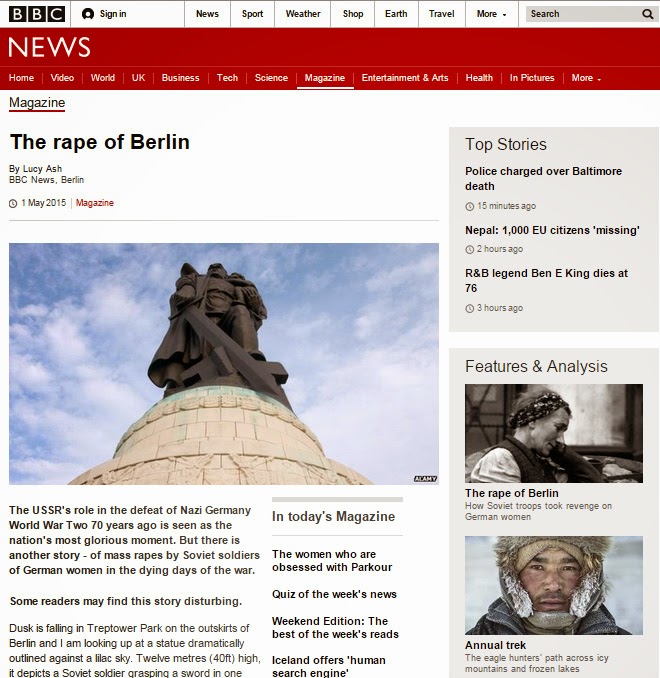
Nothing special, in fact. The BBC has just shitted out another congratulation to the former ally with the coming 70th anniversary of the victory over Nazi Germany. Just another one piece of shit in the long row.
The text contains same names, Beevor and Gelfand, used to prove the denigrating statements with same delusionary figures of raped women. And, by the way, the very same photograph of a Red Army soldier apparently taking a bicycle from a German woman. Just to create the necessary atmosphere of horror that ruled civilized Germany somehow defeated by Mongoloid hordes of the Red Army bolsheviks.
There is no caption to the image, and no doubt an average reader would perceive the preceding and following paragraphs as one: anger, revenge, hatred.
But this is a pure and mean manipulation and bullshit. Old-fashioned anti-Soviet Russophobic bullshit. Here goes the original caption to the original uncut image.
But it's not just a tall tale. It's not just a fruit of Tom Rob Smith ill imagination. It's worse.
In fact, it's an act of decades long Russophobic campaign of dehumanization of Russia/USSR. It's not just a fiction; it's an act of information war. And an offence, which I take to my account as well, as it is an offence to my country.
I feel myself obliged to go a bit deeper so that my feeling was understood better.
I see that Mr. Tom Rob Smith tries to describe the Soviet life of early 1950-s with all the black paint he can find in... the Western history.
It was on April 12, 1961, that the Union of Soviet Socialist Republics opened the age of manned space exploration. Just 3,5 years after it launched the first Sputnik.
Thousands people remember the day alike:
We were sitting in classroom, when school administrator run in and cried: "Switch on the radio! Man in space!"
The day became a spontaneous day off, day of celebration of the great, but already expected achievment.
Gagarin in Vostok's cabin during preflight checks before takeoff.
Not that I am going to say that the Time lied; but it was surely not fully correct. And the matter is not the space suit invented by the magazine cover's artist.
Just like the USSR was more than Russia (which was the biggest and, say, the first among the equal, but nevertheless one of fifteen Soviet republics), so Gagarin was more than Russia's. He was surely Russian; bu first of all he was Soviet. He was a young, exemplary Soviet man. Surely, a Communist party member.
What is the most important and impressive about this day, is that the invincible power of Soviet rocket science put Yuri into space less than 16 years after the USSR survived he most devastating and exhausting war in history.
This is one of those true miracles the Soviet history showed to the world.
I feel a great pity for all those who were afraid of its successes. That is, victims of traditional Russophobic propaganda war that is still carried on.
Some unknown hackers did a nice job on March 31, 2015. They broke into web site of the Lihuanian Genocide* and Resistance Research Centre and added some documents from the file of agent Magnolia. That is, Dalia Grybauskaitė, President of the Lithuania.
In fact, there were plenty of rumours regarding her father's cooperation with NKVD (Stalin's age title of the Ministry of Internal Affairs), and her own being an agent of KGB. Surely, she and her office has always commented these rumours as false and provocative.
Finally, there are documents. At leas the one that I copied.
[Left upper corner, so called 'corner stamp']
(Coat of arms of the USSR) USSR Ministry of Internal Affairs CHIEF DIRECTORATE OF INTERNAL AFFAIRS of the Executive Committee of the Leningrad City Council (Soviet) of People's Deputies
At May 31, 1982 [Outgoing] No. D/Z-1551
Direction of Militia's** Special Service
[Right upper corner, address part]
Copy No. 1 TO THE RECTOR OF THE LENINGRAD STATE UNIVERSITY NAMED AFTER ZHDANOV comrade ALESKOVSKY V.B. City of Leningrad
(Handwritten) To V.N. Filinov (the 5th and 6th Cyrillic letters are hardly legible)
(Signature is illegible) June 11, 1982
[Main body]
This is to inform you that on May 22, 1982, at 22:40 in the bar of "Pribaltiyskaya" hotel, men of the special department of the Chief Directorate of Internal Affairs of the city of Leningrad as a result of documents check determined citizen Gribauskayte Dalya Polikarpo, born on March 01, 1956, born in the city of Vilnius of the Lithuanian Soviet Socialist Republic, who presented a student's ID No. 775343 of a sudent of the evening (part-time) department of the Leningrad State University named after Zhdanov.
I've just come across an interesting FB post by Rauf Kubaev*. Here goes my translation of it.
There is no answer to me.
How did it turn out so that the bloody — without irony — Soviet regime had brought up the whole generations of decent people?
How did it turn out that the most brutal power generated the whole generations of conscientious, sympathetic, tolerant to other races and religions people?
How did this dark substance — the Soviet power — influence minds and conscience, that the definition "a Soviet person" had no relation to actual Soviet power?
Why did we remain people under the bloody — without irony — regime, and now, at total freedom, we turned into animals?
Why do we prefer to show the Soviet animated films to [our] children, while trying not to show the modern ones?
I have no answer.
Quite a good questions on the way to realize the very essence of the Soviet period of Russian history. The next steps would be question if the Soviet power was that bloody and brutal and dark in essence, at least (or even especially!) in comparison with other contemporary powers. A good question would also be, what are totalitarianism and democracy, and how totalitarian was the Soviet regime at differemt stages of its existence in comparison with other 'democratic' regimes of past and present.
Anyhow, this is just the right way to real knowledge: to ask deep and serious questions and to logically find true and unbiased answers.
*) Rauf Kubaev is a Russian novellist, screenwriter, director and producer of Uzbek descent. Being born in 1956 in Bukhara (the Uzbek Soviet Socialist Republic of the USSR, now the Republic of Uzbekistan), in 1989 he moved to Moscow, and later entered to and graduated from the Gerasimov Institute of Cinematography (VGIK). Since 1993, he took part in production of some popular movies and pretty successful TV-series. In my opinion, he is kind of a splinter of the true Soviet national intelligentsia, that was brought up across the whole USSR.